His Majesty, the Infant

I don’t know what the deal was exactly, but I have noted that in pictures of me from about 6 to 18 months I am elevated or stuck up on top of things.  A fence post in one case; atop a hay wagon in mewheelbarrowanother; on the hood of the Reo, and in another case on the fender of the Reo. Also seated in a wheel barrow.  In all cases, my feet are not touching the ground; you might think I had something against earth.

I was being posed in what was perhaps a fad of the era.  Put Baby up on something high, and if he is not up on something high, you get down on your belly and point up with the Brownie so it looks like Baby is up high somewhere.

But I am pretty sure this is not a fad, but more a case of Freud’s “His Majesty, the Infant.”  Baby is elevated because baby is King.  In the infant, Freud says, the adult sees his or her own narcissism reflected back in a way that can be admitted into the light of day.  If that’s the case, then Joan, who am I pretty sure was responsible for my various placements, was pretty grandiose since she insisted on my being elevated in Kingly fashion.

But then brother Steve has long claimed that Joan thinks she is the Queen of England.

I for my part did not apparently always like being posed or stuck high up on things.

In this photo clearly I am somewhat distraught at having been stuck in that ugly-assed wheelbarrow, that is not, as I look more closely, a wheel barrow at all but most probably a fertilizer distributor. Possibly I did not feel the fertilizer distributor a truly regal conveyance.

ProtoDork

When recently I assisted, one day, in helping my brother’s clean out Joan’s house for the purpose protodorkf selling it, I was given the responsibility of collecting the pictures and other documents Joan had stuck in a cedar chest or left lying about.  I spent some hours over this Christmas break plowing through the stuff, sorting out pictures I found of historical interest largely.  I found also a couple of envelopes: one labeled Dan and another Dave, containing pictures of my brothers Dan and Dave respectively.

I gave Dan his envelope of picture stuff on Christmas day.  We went through it and got a couple of laughs, and Dan on his blog has used some of the pictures to tell the story of his early years as a dork.  Well, not as a dork, exactly, but as a dorklike person in the land of dorks.  He told me that he almost pissed his self laughing at that Napoleon Dynamite movie.  I didn’t think the movie was funny really, just sort of sad, and peopled largely with drooling idiots.

But Dan is 14 years younger than I and completely a California Kid born and raised.  Fads come and go quickly under late consumer capitalism.  I was spared the Dork phenomenon.

I have got to mail Dave his envelope of picture stuff but I keep forgetting.

The Old Reo

The Old Reo was called the Old Reo back then in 1945, so who knows how old the Old Reo was reoeven then.  Over the years that car became for me a sort of mystical and mythical beast—the car I rode in to get from San Diego to Ora, South Carolina.  Some might say we were going in the wrong direction, but who cares.  We went where ever we went in the Old Reo.

Suffering as all kids do from Infantile Amnesia, I have no recollection of the trip; and by the time I started having a memory the Old Reo was defunct.  I remember it only as a car carcass sitting past the barn at Grandma’s place and slowly sinking into the weeds.  It did not decay as most old cars do via rust, but actually rotted since a good portion of its frame and paneling was wood.

 So that’s me in the Old Reo with the old man.  The Old Reo was probably related to the more famous Reo Speedwagon.  Along the hood of the truck—for I think the old Reo was technically a truck—appears in a little inlay the word Delivery.  This is in another picture and I cannot make out the word before Delivery because I am sitting in front of it.  But this suggests the Old Reo was a Delivery Truck.

If this is the case, in all likelihood, the truck probably had only a front seat and a lot of room in the back for other stuff.

So we crossed the County in a Reo Delivery Truck.  And so we were Delivered.

The Old Homested

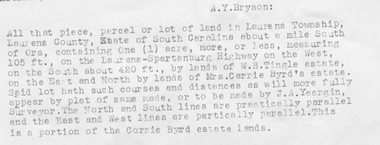
Below please find the official legal description, duly signed and notarized, for the former Tingle family acerage near Ora, SC.

acre 

Apparently, WB couldn’t get any bank to lend him the money for the land; after all he lacked any collateral, except maybe that white mule.  So he borrowed the money from AY Bryson.  1800 bucks for one acre.  I don’t know but that seems a bit steep to me for one acre back in 1946.  But maybe he was paying for the prime location.  Below please find the terms for the loan:

terms 

 And from the Greenville News, date line Wednesday, November 3, 1948. I sadly report:

Jasper Barton, 50, Route 1, Woodruff, was still in poor condition last night at General Hospital where he was admitted Monday for treatment of injuries recveived when a mule reportedly struck him while Mr. Barton was trying to hitch him to a wagon.  What the mule struck Mr. Barton with is still unknown. 


How Poor Were We?

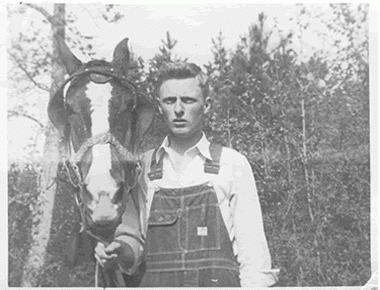
Brother Dan upon reading a recent entry wondered why the heck WB did not build a house—after all, it was a new house—back in 1947 with an indoor toilet in it.  That’s a good question really that I wbhorsedon’t know how to answer.  Maybe it was just tradition.  Grandma didn’t have indoor plumbing either. This question is also related to another raised by brother Dan and that’s how poor were we back then and there.

I do think money had something to do with not have indoor plumbing and tradition might have made it easier to go without.  We did, as I said, have our own well, and WB ran pipe into the kitchen.  We had running water there and I do believe the water ran also to the washing machine.  But that part of the house—the kitchen and the little porch with the washing machine—directly adjoined the well.  So the house had water but no bathroom had been built, so no water could get to what wasn’t there.

So how poor were we?

We were so poor the rats dined out.  Ha ha.

We were so poor the roaches became cannibals. Ha ha.

I don’t know how poor we were.  I know WB went back with the idea of growing cotton and being a farmer, and that did not work out AT ALL.  He was trying to make ends meet with the assistance of a white mule. So when the house was built they just may not have had the ready money for the extra room that would have been the bathroom and for the appointments—like a toilet—that go along with a bathroom.

I don’t remember having been hungry in a really unpleasant gnawing at your stomach way, though I do remember having occasionally really wanted that last pork chop or part of it anyway.  The kitchen table, though, according to Joan, was not a proper table but a table frame to which WB had tacked a piece of plywood.  Seems as if we could have gotten a proper table from somewhere, but apparently not.  Also I did not have a proper chair or a chair proper at the table.  My seat was a nail keg.  I imagine brother, Steve, sat in a highchair as long as they could keep him there.  I don’t know what he sat on when he was big enough for a chair proper.

The hot water heater was right there in the kitchen with us and not off in its own little room as is the custom today.  We did not go in the kitchen when there was lightening because sometimes a nearby strike would cause a bolt of blue electricity to arch across the kitchen from the wiring on one side of the room to the refrigerator on the other side.

Joan also paints a pathetic picture of her driving into town, clutching me to her bosom, tied down by a rope to the front seat, because her side of the vehicle had no door.

So, overall, I think a money shortage might have had something to do with the lack of an indoor toilet.

The Marston Clock

This guy is my mother’s father.  His last name was Kaller or at least that’s what he said.  He also said he was an orphan.  One night his brother got angry with him and told him that he wasn’t his kallerbrother but was adopted.  And when he found out that was true, he ran away and joined the circus.  I find that hard to believe.  Ran away and joined the circus?  Give me a break.  Everything about this guy reeks of cheap novels.

I never met him.  By the time, we moved back to San Diego he was dead.  Once we went to a tailor’s shop in downtown San Diego back when that little square in the middle of town was where the prostitutes hung out.  The shop was on a little side street and I remember staring at this poster on the wall that depicted that pyramid on the back of the dollar but with a really huge eye on the top.  The tailor saw me looking and said that had belonged to my grandfather who was first degree mason and that the poster depicted some sort of Masonic symbol.  I guess we had gone there so my mother could ask the tailor about her father’s last days.

I don’t know if it was that time or another but we were down town back when the only shopping around—before the malls came in—was at the downtown department stores, and my mother caught sight on this fancy clock, on the top of a fancy pole, outside the Marston’s Department store and she just started bawling and bawled all the way home, and we had to wait a number of days till we heard the story of the Marston clock.

She was 18 years old and had a job in a department store.  And going home she was standing beneath the Marston clock when this man came up to her and asked her what time it was, and she didn’t say anything, but pointed up to the Marston clock, and the man said thank you and moved on.  I thought maybe the guy had been trying to pick up on the old lady, though I couldn’t see why frankly.  But it turned out that the man who asked the time had been her father, and he hadn’t even recognized her. That’s why she started crying every time she saw the Marston clock or any time she told the Marston clock story.

No reason really he should have recognized her.  He had abandoned her and her sister and her mother back when my mother was 10 or so.  The guy was a real reprobate.  He was married six times.  He married one woman, who was pretty loony, for her money, took all her money, had her committed, and then divorced her.  He was a good cook and a real charmer, life of the party sort.  He would start a restaurant, get it up and going, and then blow all the money on the ponies, and then start another restaurant or marry some woman for her money.

 Once I am in New York City before you could get any book in the world off the web and I hit the book stores pretty hard.  One day I am hanging out in the big Barnes and Noble, and I come upon this history of the Klu Klux Klan.  I find myself thumbing through it and then scanning the index for mention of my grandfather since he had been during the early thirties Grand Dragon of the KKK for the Western States.  That was the story in any case. Who knows, though; the guy was a damn liar and a pathological opportunist.

Cats and Goats

My brothers—mostly my brothers—and I had to clean out our mother’s house so we could sell it.  As the family historian, or the one interested in such things, or with the time to do it, I took charge of house1947a couple of boxes of pictures and documents that our mother kept in a cedar chest, and a few days back I pulled out one of the boxes and started going through it.

 That was a mistake.  I am never in a good mood and doing that, looking at pictures of a bunch of dead people from long ago, didn’t help my mood any.  But I found this picture and I think at some level I have been thinking around and about it since I first saw it. But I don’t know what I am thinking about exactly and whatever it is seems pretty confused and full of conflict.

That’s a picture of the first house we lived in when the old man took us back to South Carolina after WWII to grow cotton.  I think the house had electricity but it didn’t have running water or in door bathing and toilet facilities.  I appear to be looking at or for something in the grass.  Off to my right is a cat high tailing it out of the area.  A shovel leans up against the wall, and the screen on the door to the porch is a particularly thick and rusty kind of screen that’s hard to describe but you would know it if you have seen it.  Whenever I have seen it I have wanted to touch it.  It has that effect.

I don’t remember the day of course or the house.  I wish I remembered the cat.  But I do recognize the kid.  That’s me, OK.  I know that.  But I have a difficult time making the connection between me, as I sit here at a computer looking out the window at the California mountains about 58 years later, and that kid.  But I do feel a sort of personal, though generic, attachment.

I say generic because in general I like little kids about that age.  Whenever I bump into a little kids about that age I say hello, or sometimes, if I am wearing it, I take off my hat so they can see part of my head come off.  Usually, they don’t mind.  My conversations with these little kids are pretty brief, and I almost always find them satisfying.  I can’t say much passes between us, but enough I expect. What’s there to say but hello and then goodbye?  That’s probably the most basic and fundamental conversation anyway, hello and then goodbye.  That sort of wraps it up, I think.

I am glad the cat is in the picture.  I must have disturbed it—the way it is high tailing it out of there—just moments before the picture was taken.  When I first saw the picture I thought it was a little weird-assed goat with a long tail sticking up, but that didn’t make any sense; then I saw that what appeared one of the ears of the goat was in fact the right front leg of the cat.

I like animals too and I try to communicate with them whenever possible.  While I am very fond of cats, it would have been cool if the cat had been a goat.  I know we kept goats now and then.  Goats are an under-rated animal, pretty interesting, and even a little intelligent, I think.  Not like sheep or your basic fleshy fat cow.  They have a dull and dead look in their eyes.  But a goat will recognize the person who feeds it.  Cows—they don’t give a damn who you are.  They just want to be fed.

Exhibit B: The End of Tingle Road

As I established by Exhibit A in my last entry, Tingle Road, as I will always know it, started not very far from the Paron Primitive Baptist Church, ran North then for a number of miles, hung a left, as it approached the county line between Monroe and Butts Counties, crossed Brownlee, and terminated at High Fall Roads.
highfallsign
Since the South end of Tingle Road had no street sign and only local opinion to give it official stature as any thing other than one of hundreds of nameless dirt roads, my wife and I made a point of driving to the Northern End, and there located Tingle Road in its black topped manifestation complete with street signs as documented here .

When I first devoted a web page, now scrapped, to Tingle Territory, I had to look high  and low for maps.  Now maps abound on the web, and so to check my memory, and my facts, and to see if there was more of Tingle Road than I had thought at the time, I googled Tingle Road and much to my displeasure found that it had significantly shrunk.

The green tack—Istoodhere—in the google image marks the intersection of High Falls and Tingle Road where I stood to take the picture above of the street sign marking the corner of High Falls and Tingle Road, but as the viewer will no doubt note directly to the right of the marker is a road called “Teagle” not “Tingle.”  Apparently, I will never again be able, should I wish, to stand at the corner of Tingle and High Falls Roads.  The whole upper end of Tingle Road has been changed to Teagle Road on MSN maps as well as Google.  istoodhere

I asked you, dear reader, what possibly could have been gained by this change from Tingle to Teagle.  Perhaps the locals didn’t like the sound of Tingle and so changed it to Teagle or perhaps some stupid redneck failed to copy Tingle correctly and had signs made up as Teagle.  tinytingle

And just as perturbing, if not more so, The Red Dirt Tingle Road near the Paron Church has also disappeared.  I direct the viewer’s attention to the tiny Bit of Tingle Road (microsoft map) that now runs into something called “Gordon” Road.  Why this part of Tingle Road is called Gordon Road I have no idea.  Who is this Gordon person?  All that remains now officially of Tingle Road is that little bit of the triangle, hardly a quarter mile long.  Better to have wiped out the whole road rather than leave that mockery of a vestige of its former robust self.

Exhibit A

Exhibit A, so called, is the first piece of evidence in the mystery of the vanishing of Tingle Road.  The Tingle Road, of course, of which I speak, is the one resting at the center of my Particular Tingle Territory, the one located at the upper or northern edge of Monroe County, GA, itself located monroemapmidway between Atlanta and Macon off inter state 75.  That’s the thing I most wanted to see, when I went in 1994 to visit my people in the South,  not for the beauty of the spot, it being after all just a dirt road pretty much in the middle nowhere and not much to brag on, but to see if it actually existed, as family had suggested it did.  Not that I doubted their word, but it was just one of those very, very few things in my life I have felt the need to see with my own eyes.

So when I was back there and had the chance, my wife and I drove down 75 and then took Route 42, at the center, as you the viewer will see, of Exhibit A, up to little known, because little populated, Blount, Georgia.  There we found, as indicated in the yellow blotch in the middle of Exhibit A, the Paron Primitive Baptist Church, that had among its founders, in 1823, a number of ancestral Tingles, whose bones rested directly adjacent on the one side to the church, and  was directly adjacent, as brought to my attention by elderly bent old woman, on the other side to Gregory road which, if I took that would take me a piece, over a little bridge, and right beyond that the entrance to the southern end of Tingle Road, though I should keep my eye peel it being somewhat overgrowed. 

If the reader or viewer would take a moment to direct his or her attention to Exhibit A, he or she will see that things were just as the elderly lady, living repository of local history, had indicated.  Though, the end of the road was not so overgrown, having only a few branches overlapping it, and once one got through those, the road stretched out pretty much open and straight ahead as pictured two entries ago and worth, I think, repeating here.  troad1I drove this stretched as far as I could in my rented car until my wife freaked out when we crested a little knoll and Tingle Road just ahead became a little boggish, no doubt from recent rains.  I was still not quite deterred, and walk aways ahead to determine the depth of the water.  When though I sunk up to my ankles in the red mud, I decided that we had reached the end of the road figuratively speaking.

I can’t say then that I have seen all of Tingle Road with my own eyes, for I failed to drive it end to end as I had wished, motivated by some strange irrational urge to see the whole damn thing.  I don’t know how long the road is exactly, but as the alert viewer, reader will note in Exhibit A, Tingle Road runs on up to cross Route 42, past the Webb Cemetery, across Brownlee, and then runs on a bit more (not pictured here) to High Falls, acting for a way, as it goes, as marking the line between Monroe and Butts Counties.  It terminates, rather abruptly at High Falls, I say abruptly because while the dirt road continues to run some ways, officially it’s called Country Road.

That’s how things were back in 1988 when the map of Monroe County was map, and when I visited in 94 and again in 98, but that’s not how it is today if current documentation is to be trusted.

To be continued…..

Tingle Territory?

I found when I would wake up at 530 and it’s pitch dark outside and I am painfully buzzing from effexor withdrawal that I could steady myself a little by compulsively futzing around with the tingleroadcomputer.  I supposed in the olden days I would have taken out my knife and whittled all day.  But the computer has its own way to whittle things, and so I launched into a project I have entertained for some time, and that is to construct a web page for what I call Tingle Territory.

But once again I pooped out and the further I went to the project the more futile it felt.  Part of the problem is one’s audience.  Who the hell are these Tingles?  Well, I have found that throughout the USA one can locate a goodly number of Tingles, though obviously, this odd name is infrequently heard. I am trying feebly to say there is potentially at least more than one Tingle Territory because one can find more than one Tingle and they have all been in different territories or parts of this USA.

So I find it a bit pretentious or possibly grandiose to put up a page called Tingle Territory as if my tiny piece of Tingle Territory is the whole story.  Some Tingles on line out there in the Ether might go to my Tingle Territory and not be pleased.  I don’t want to offend any Tingles, for they are a fierce bunch. 

Or they are fierce, if, as I believe to be the case, most Tingles in the USA share common genetically linked Ancestors.  Most of the Browns or Smiths or Bushes in this country are probably genetically unlinked.  But the rarity of the Tingle name alone suggests a likely linkage.  Who would voluntarily take on that name, I ask.  Also the little I have gathered about Tingle genealogy suggests common ancestral and genetic links.

Rumor has it that six Tingle brothers came to the Colonies in the 1680’s.  I can trace my line back to a Solomon Tingle, known to be in the colonies in the early 1720’s and, though I cannot document it, I think it logical to infer he was the son of another Solomon Tingle, one of the original six.  The brothers appeared to have fanned out across the country.  I was driving through the “historic” district of Cincinnati once and stumbled on the Tingle House.  An elegant old structure once owned by a William Tingle who owned and operated a brick making plant.  Also, a Google Search documents a pretty large number of Tingle Roads and even Bridges scattered across the country from Maryland to Washington.

I have to believe these roads and bridges were named after people named Tingles who either lived near by or owned the land through which the roads ran and which, at watery places, were sustained by Tingle bridges.  The “Tingle Road” in my family line is located near Blount, Georgia.  That’s where my particular line, fathered by one of those six Tingle Brothers, headed, down South, by way of North Carolina to arrive in Georgia in the early 1800’s.

I don’t know if this is why things start, after a point, every time I try to write up a Tingle Territory page, to feel futile and a bit overwhelming.  My Tingle Territory is but a tiny bit of Tingle World.  Maybe, I could solve my problem by giving the page a different name, but I refuse to yield that alliteration.